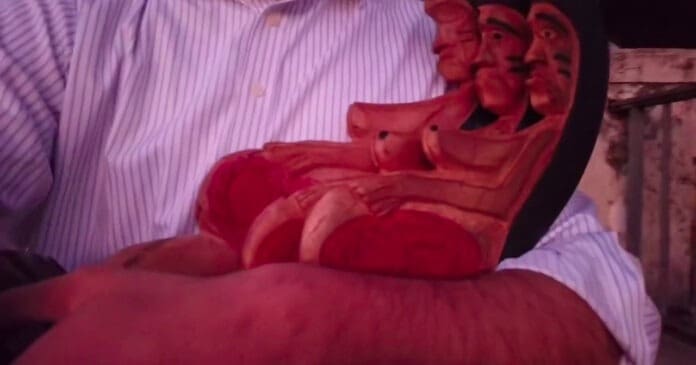
The man who threw the controversial Pachamama statues seen at the Amazon synod into the Tiber published a video explaining the reasons why he did it.
“You shall not make for yourself an idol or a likeness of anything in the heavens above or on the earth below or in the waters beneath the earth.” – Exodus 20:4
Nearly two weeks ago, footage was anonymously uploaded to YouTube showing the controversial Pachamama statues seen at various events during the Amazon synod being taken from the church of Santa Maria in Traspontina and thrown into the Tiber River.
Later, Pope Francis announced their retrieval of the Pachamama statues and issued an apology for the actions of the two unknown men. Now, the same channel that uploaded the video uploaded another with a man explaining why they did it.
In the video “Why we threw the Pachamama idols into the Tiber river” dated November 4th, Alexander Tschugguel, 26, from Vienna, Austria claims he and another took the five statues from the church because they “saw in those statues and in those idols a break of the First Commandment.”
In Rome covering the Amazon Synod, he spoke to volunteers inside the Santa Maria in Trasponita who said the statuts were “signs of fertility, of Mother Earth, and integral ecology.” He said the synod left him “very disappointed” and was “a big mixture of wrong ideas, social justice, liberation theology,” that “goes hand in hand with the globalist agenda.”
Tschugguel said before going through with it, he consulted with a priest and prayed many rosaries with his wife: “The spiritual preparation was everything.” He rejected the idea his actions was “theft” because “pagan idols” don’t belong in a Church, saying his sole motivation was to “bring pagan things out of a Catholic Church.”
“Please, Holy Father, understand this, as Catholics, we just don’t want pagan things in the Catholic Church. We want our churches to be clean and pure about the Faith and we want the Church to follow Jesus Christ and that’s it.”
He founded the Saint Boniface Institute, an organization for Catholic laymen who want the Church to live out traditional teachings. He is also active on Twitter: @ATschugguel
Love uCATHOLIC?
Get our inspiring content delivered to your inbox every morning - FREE!
Halloween’s origins are, in fact, very Christian. Halloween falls on October 31 because of a Pope, and its observances are the result of medieval Catholic piety.
We’ve all heard the allegations: Halloween is a pagan rite dating back to some pre-Christian festival among the Celtic Druids that escaped church suppression. Even today modern pagans and witches continue to celebrate this ancient festival. If you let your kids go trick-or-treating, they will be worshiping the devil and pagan gods.
Nothing could be further from the truth. The origins of Halloween are, in fact, very Christian and rather American. Halloween falls on October 31 because of a pope, and its observances are the result of medieval Catholic piety.
It’s true that the ancient Celts of Ireland and Britain celebrated a minor festival on October 31–as they did on the last day of most other months of the year. However, Halloween falls on the last day of October because the Solemnity of All Saints, or “All Hallows,” falls on November 1. The feast in honor of all the saints in heaven used to be celebrated on May 13, but Pope Gregory III (d. 741) moved it to November 1, the dedication day of All Saints Chapel in St. Peter’s at Rome. Later, in the 840s, Pope Gregory IV commanded that All Saints be observed everywhere. And so the holy day spread to Ireland.
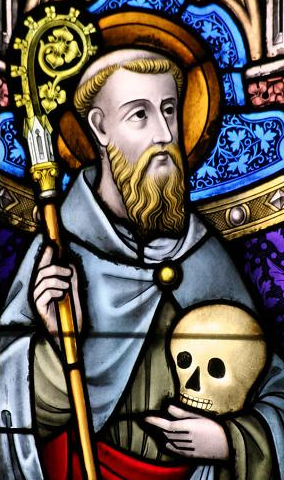
Saint Odilio of Cluny
The day before was the feast’s evening vigil, “All Hallows Even,” or “Hallowe’en.” In those days Halloween didn’t have any special significance for Christians or for long-dead Celtic pagans.
In 998, St. Odilo, the abbot of the powerful monastery of Cluny in southern France, added a celebration on November 2. This was a day of prayer for the souls of all the faithful departed. This feast, called All Souls Day, spread from France to the rest of Europe.
So now the Church had feasts for all those in heaven and all those in purgatory. What about those in the other place? It seems Irish Catholic peasants wondered about the unfortunate souls in hell. After all, if the souls in hell are left out when we celebrate those in heaven and purgatory, they might be unhappy enough to cause trouble. So it became customary to bang pots and pans on All Hallows Even to let the damned know they were not forgotten. Thus, in Ireland at least, all the dead came to be remembered–even if the clergy were not terribly sympathetic to Halloween and never allowed All Damned Day into the church calendar.
But that still isn’t our celebration of Halloween. Our traditions on this holiday center on dressing up in fanciful costumes, which isn’t Irish at all. Rather, this custom arose in France during the 14th and 15th centuries. Late medieval Europe was hit by repeated outbreaks of the bubonic plague–the Black Death–and it lost about half its population. It is not surprising that Catholics became more concerned about the afterlife.
A Danse Macabre
More Masses were said on All Souls Day, and artistic representations were devised to remind everyone of their own mortality. We know these representations as the “danse macabre”, or “dance of death,” which was commonly painted on the walls of cemeteries and shows the devil leading a daisy chain of people–popes, kings, ladies, knights, monks, peasants, lepers, etc.–into the tomb. Sometimes the dance was presented on All Souls Day itself as a living tableau with people dressed up in the garb of various states of life.
But the French dressed up on All Souls, not Halloween; and the Irish, who had Halloween, did not dress up. How the two became mingled probably happened first in the British colonies of North America during the 1700s, when Irish and French Catholics began to intermarry. The Irish focus on Hell gave the French masquerades an even more macabre twist.
But as every young ghoul knows, dressing up isn’t the point; the point is getting as many goodies as possible. Where on earth did “trick or treat” come in? “Treat or treat” is perhaps the oddest and most American addition to Halloween and is the unwilling contribution of English Catholics.
During the penal period of the 1500s to the 1700s in England, Catholics had no legal rights. They could not hold office and were subject to fines, jail and heavy taxes. It was a capital offense to say Mass, and hundreds of priests were martyred.
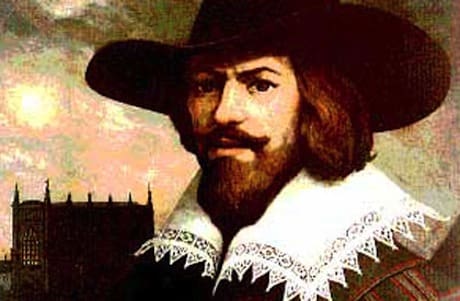
I wonder if they make a Guy Fawkes Halloween mask…
Occasionally, English Catholics resisted, sometimes foolishly. One of the most foolish acts of resistance was a plot to blow up the Protestant King James I and his Parliament with gunpowder. This was supposed to trigger a Catholic uprising against the oppressors. The ill-conceived Gunpowder Plot was foiled on November 5, 1605, when the man guarding the gunpowder, a reckless convert named Guy Fawkes, was captured and arrested. He was hanged; the plot fizzled.
November 5, Guy Fawkes Day, became a great celebration in England, and so it remains. During the penal periods, bands of revelers would put on masks and visit local Catholics in the dead of night, demanding beer and cakes for their celebration: trick or treat!
Guy Fawkes Day arrived in the American colonies with the first English settlers. But by the time of the American Revolution, old King James and Guy Fawkes had pretty much been forgotten. Trick or treat, though, was too much fun to give up, so eventually it moved to October 31, the day of the Irish-French masquerade. And in America, trick or treat wasn’t limited to Catholics.
The mixture of various immigrant traditions we know as Halloween had become a fixture in the United States by the early 1800s. To this day, it remains unknown in Europe, even in the countries from which some of the customs originated.
But what about witches? Well, they are one of the last additions. The greeting card industry added them in the late 1800s. Halloween was already “ghoulish,” so why not give witches a place on greeting cards? The Halloween card failed (although it has seen a recent resurgence in popularity), but the witches stayed.
So too, in the late 1800s, ill-informed folklorists introduced the jack-o’-lantern. They thought that Halloween was Druidic and pagan in origin. Lamps made from turnips (not pumpkins) had been part of ancient Celtic harvest festivals, so they were translated to the American Halloween celebration.
The next time someone claims that Halloween is a cruel trick to lure your children into devil worship, I suggest you tell them the real origin of All Hallows Eve and invite them to discover its Christian significance, along with the two greater and more important Catholic festivals that follow it.
Father Augustine Thompson, O.P., is an associate professor of religious studies at the University of Virginia. BA, MA, The Johns Hopkins University; BA (Philosophy), MDiv, Dominican School of Philosophy & Theology; PhD, University of California, Berkeley; STM, Order of Preachers, 2007.
Reprinted from Catholic Parent magazine. Copyright 2000. All rights reserved.
Love uCATHOLIC?
Get our inspiring content delivered to your inbox every morning - FREE!
A title typically seen for the heads of the Eastern Catholic Churches, did you know there are patriarchs in the Western Church other than the Pope?
“A patriarch is a bishop who enjoys power over all bishops including metropolitans and other Christian faithful of the Church over which he presides.” – Code of Canons of the Eastern Churches 56
However, the Patriarch of the West is not the only one. Within the Western Church, there currently exists 5 titular patriarchates.
“The titles of patriarch and primate entail no power of governance in the Latin Church apart from a prerogative of honor unless in some matters the contrary is clear from apostolic privilege or approved custom.” – Code of Canon Law 438
In the Latin Church, titular patriarchates exist merely as an honorable designation without any jurisdiction over other metropolitan bishops, with precedence to the patriarchs and cardinals of the Eastern Catholic Churches as well.
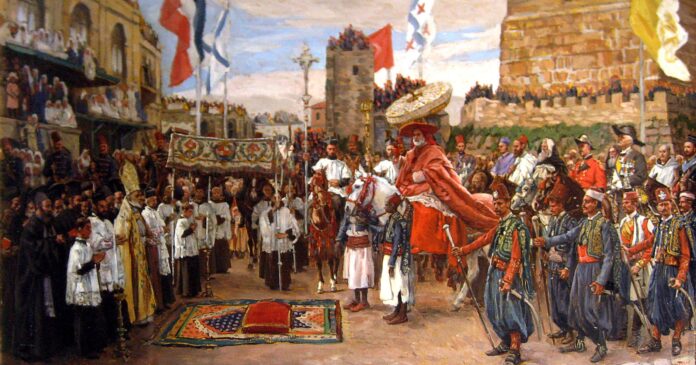
Today, there are 4 active Latin titular patriarchates: the Patriarch of Lisbon, headed by Rui Valério; the Patriarch of Venice, headed by Francesco Moraglia; the Patriarch of the East Indies, headed by Filipe Neri Ferrão; and, the Patriarch of Jerusalem, headed by Pierbattista Pizzaballa.
There is also 1 vacant Latin titular patriarchates. The Patriarch of the West Indies has been sede vacante since the death of Leopoldo Eijo y Garay in 1963, and is considered unlikely to be filled.
Throughout Church history, 5 Latin titular patriarchates have existed but have been later suppressed: the Patriarch of Alexandria, Antioch, and Constantinople were suppressed in 1964. The Patriarch of Grado was suppressed in 1451, and the Patriarch of Aquileia was suppressed in 1751.
A curious case exists when the Pope confers the title of patriarch ad personam to a bishop without a see or any jurisdiction to preside over. This has only happened one time in history, to Alessandro Cescenzi on February 24th, 1676, given a personal title of patriarch.
In an increasingly secular world that eschews the spiritual for the material, how can we lead a holy life? The Angelic Doctor has a prayer just for that.
“but, as he who called you is holy, be holy yourselves in every aspect of your conduct,
for it is written, ‘Be holy because I [am] holy.'” – 1 Peter 1:15-16
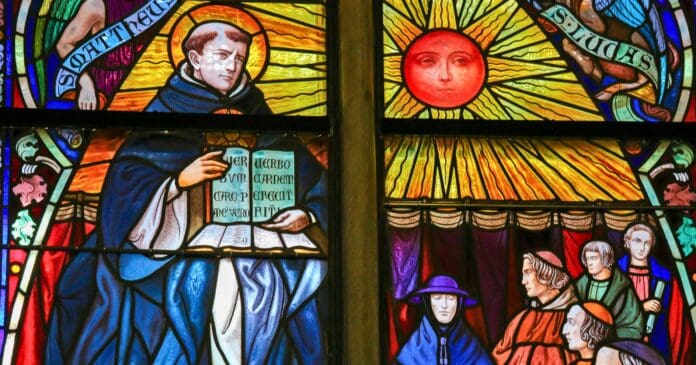
Written by Saint Thomas Aquinas, the Doctor of the Church was said to have recited it daily before an image of Christ. Known as Concede mihi, misericors Deus in Latin, it was first translated into English by the daughter of King Henry VIII at the age of 11.
If you’re experiencing a spiritual dryness – a dark night of the soul, pray this composed by the Angelic Doctor himself.
Prayer for Leading a Holy Life / for Ordering a Life Wisely /
“Grant, O merciful God, that I may ardently desire, carefully examine, truly know, and perfectly fulfill those things that are pleasing to you, to the praise and glory of your holy name. Direct my course, O my God, that I may do what you require me to do. Show me the way and grant that I may follow it as is necessary and profitable to my soul.
Grant to me, O Lord my God, that I may not be found wanting in prosperity; that I may not be lifted up by one nor cast down by the other. May I find joy in nothing but what leads to you; sorrow in nothing but what leads away from you. May I seek to please no one, nor fear to displease any. May I fear only you. May I despise all transitory things, O Lord, and treasure all things that are eternal. Let me loath all delights without you, nor desire anything apart from you. Let me find pleasure in all toil that is for you; and weariness in all rest where you are not.
Grant to me, O my God, that I may turn my heart to you always, and grieve for my failings with a firm purpose of amendment. Make me, O Lord, obedient without opposition; poor without repining; chaste without blemish; patient without murmur; humble without pretense; merry without riotousness; serious without heaviness; cheerful without frivolity; God-fearing without abjectness; truthful without duplicity; doing good without presumption; correcting my neighbor without pride; edifying him by word and example without hypocrisy.
Grant to me, O Lord God, a vigilant heart that no subtle speculation may ever lead me from you; a nobleness that no unworthy affection may draw from you; a rectitude that no evil purpose may turn from you. Grant me a steadfastness which no tribulation may shatter; a freedom that no violent affection may overthrow. Give me, O Lord my God, a mind to know you, diligence to seek you, wisdom to find you. Give me a way of life pleasing to you, perseverance to trust and await you, and finally faith to embrace you.
Grant that my punishment may be averted through penance here; your benefits used in this life through your grace; that your joys may be enjoyed in heaven in glory. Who lives and reigns, one God forever and ever. Amen.”
Editorial credit: jorisvo / Shutterstock.com
Love uCATHOLIC?
Get our inspiring content delivered to your inbox every morning - FREE!
An iconic sight of Rome: the sampietrini cobblestone roads. The unique pavement began in the 16th century when the Pope was nearly thrown from his carriage.
Although recorded history has been less than kind as to the origin of the famous sampietrini road, tradition tells the story that one night in 1585 Pope Sixtus V was travelling in the papal carriage through Saint Peter’s Square back to the Vatican apartments.
The rough, unmaintained roads caused wheel to rocket off, rocking the carriage with such force the pontiff was nearly thrown to the ground. He entrusted the Vatican maintenance staff or sanpietrini, little Saint Peters, with repairing the roads.
They decided to pave the road with small square basalt rocks, made from trimming larger basalt rocks that had been used to pave the roads of ancient Rome. Tradition says every stone laid around the Vatican represented a soul by Saint Peter. The stones, like the Vatican maintenance workers, became known as sampietrini – children of Saint Peter.
In 1736, Pope Clement VIII began covering every street in Rome with sampietrini. By the time of the Italian Unification in 1870, nearly every street had been covered with the stones, each individually hand cut and placed onto a bed of compressed earth.
In Rome, most of the sampietrini has been removed as modern transportation has not been kind to the traditional rock pavement, saved today only for areas of slow traffic with more pedestrians than vehicles.
Photo credit: Only Fabrizio / Shutterstock.com
Love uCATHOLIC?
Get our inspiring content delivered to your inbox every morning - FREE!
Although a majority have been lost to history, some of the earliest relics of the Church still survive to this day. Those associated with Jesus Christ Himself have been the most studied and fascinating of them all.
Some of these include the Holy Sponge, True Cross, and the Holy Robe. While most are familiar with these relics, many are probably unfamiliar with the Holy Lance.
The Holy Lance
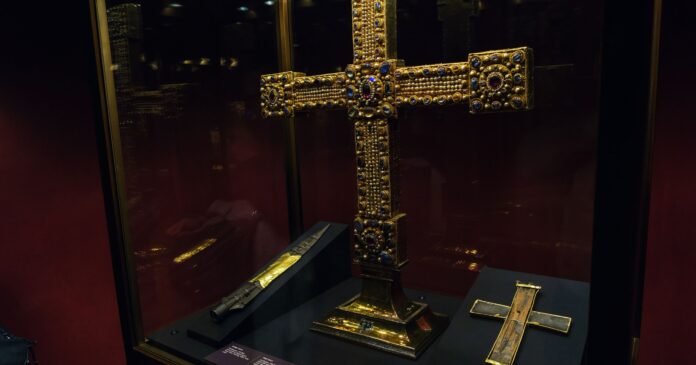
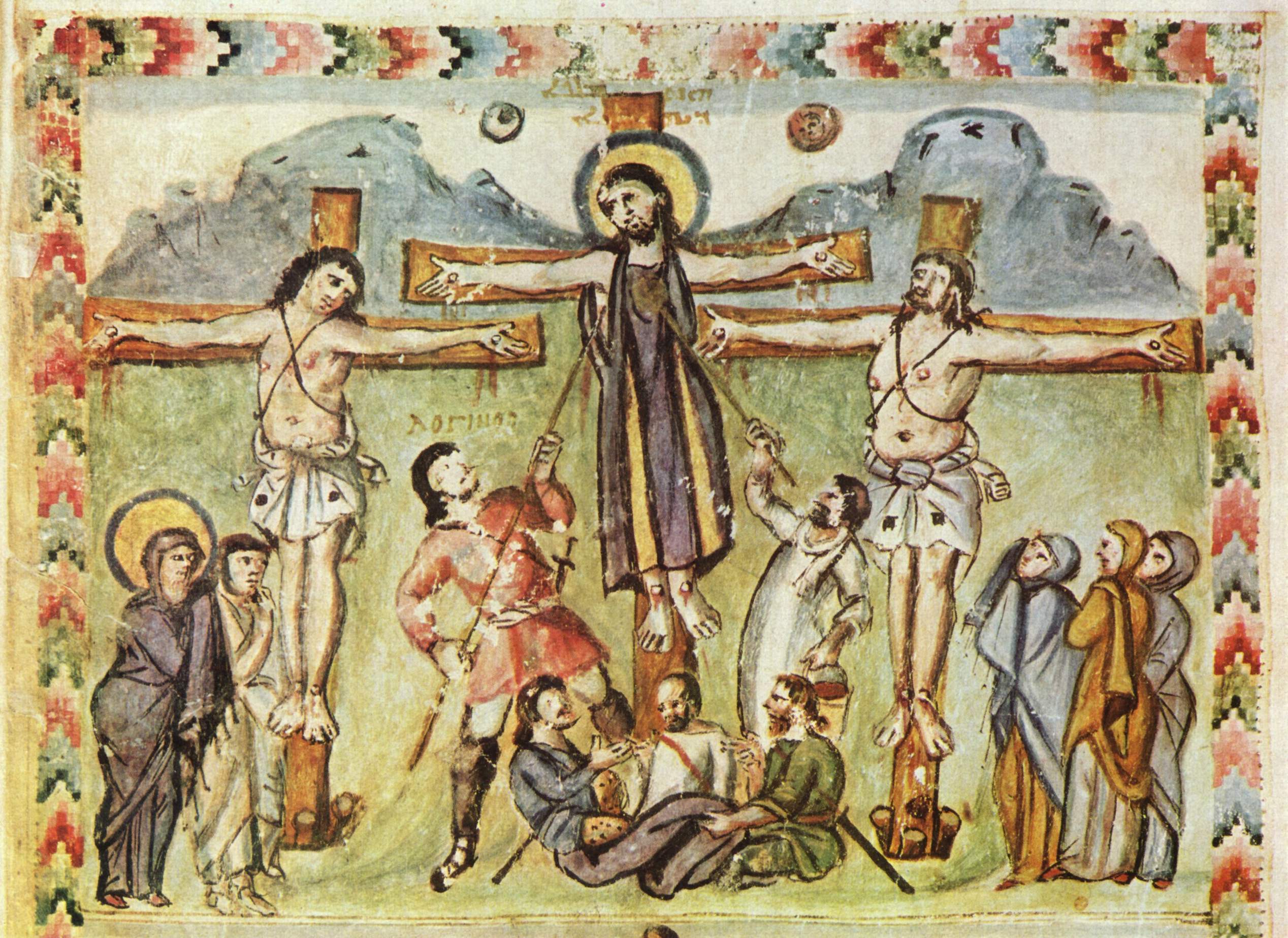
The Holy Lance is an Instrument of the Passion, Arma Christi, mentioned in the Gospel of John as used by Saint Longinus to pierce the side of Christ while on the Cross to make sure He was dead.
“but one soldier thrust his lance into his side, and immediately blood and water flowed out.” – John 19:34
The first historical reference to the Holy Lance comes from the Piacenza Pilgrim who traveled to the Holy Land during the height of the Byzantine Empire around 570 A.D. In Jerusalem at the Basilica of Mount Zion, he writes he saw “the crown of thorns with which Our Lord was crowned and the lance with which He was struck in the side.”
One of the earliest record of Saint Longinus as the centurion who pierced Christ’s side, 586 A.D. Photo credit: PD via Wikimedia Commons
Later, the Holy Lance was moved to the Church of the Holy Sepulchre as attested by Saint Gregory of Tours and Cassiodorus. In 615, when Jerusalem was captured by the Persian Khosrow II, the lance was taken to the Hagia Sophia and the broken-off point later sold to Louis IX of France. However, after the French Revolution the point was lost to history.
As for the the larger portion of the Holy Lance, it remained in Constantinople as attested by Pedro Tafur in the 1430s who saw “the lance which pierced Our Lord’s side.” In 1492, when Constantinople fell to the Turk, Sultan Bayezid II sent it to Pope Innocent VII. Pope Benedict XIV later obtained a drawing of the point still kept in France to compare the two pieces and determine its authenticity.
Today, the Holy Lance is housed beneath the dome of Saint Peter’s Basilica, despite the Church making no official claims to its authenticity. Not available to the public, it is sometimes shown during celebrations to the Faithful in the Basilica.
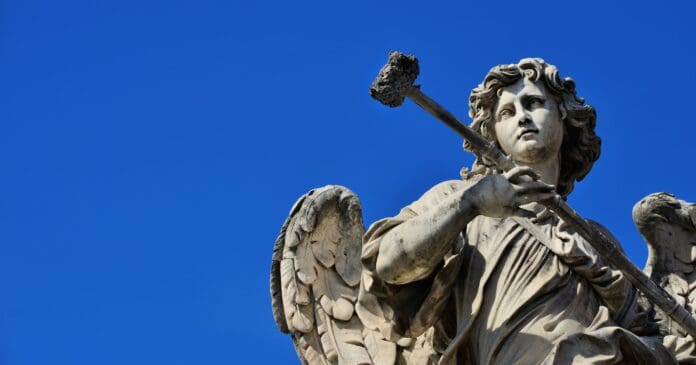
The statue of Saint Longinus in Saint Peter’s Basilica, sitting atop the relic of the Holy Lance. Photo credit: Herufra via Wikimedia
Although a majority have been lost to history, some of the earliest relics of the Church still survive to this day. Those associated with Jesus Christ Himself have been the most studied and fascinating of them all.
Some of these include the Shroud of Turin, True Cross, and the Holy Robe. While most are familiar with these major relics, many are probably unfamiliar with the Holy Sponge.
The Holy Sponge
The Holy Sponge is an Instrument of the Passion, dipped in wine and offered to Christ to drink during his Crucifixion.
“There was a vessel filled with common wine. So they put a sponge soaked in wine on a sprig of hyssop and put it up to his mouth.” – John 19:29
Tradition holds when Saint Helen of Constantinople came to Jerusalem looking for relics of Jesus, she found the Holy Sponge at Golgotha. Later, Saint Gregory of Tours and Sophronius of Jerusalem both attest they were an object of veneration in Jerusalem, the latter writing around 600 A.D. that it was venerated in the Upper Room of the Church of the Holy Sepulchre.
“and go up, my heart overcome with awe, and see the Upper Room, the Reed, the Sponge, and the Lance.”
From there, the Holy Sponge traveled to Constantinople during the Persian invasion of Jerusalem. In Constantinople, Louis IX of France purchased the Holy Sponge, taking it back to be housed in the Sainte-Chapelle. During the ravaging of the French Revolution, the Holy Sponge was dispersed in pieces, some ending up in the Notre-Dame or Bibliothèque Nationale.
Today, a fragment of the Holy Sponge is kept housed in the Archbasilica of Saint John in the Lateran, stained brown from blood. Other fragments are kept housed at the Santa Maria Maggiore, Santa Maria in Trastevere, and Santa Maria in Campitelli in Rome.
Photo credit: Cris Foto / Shutterstock.com
Love uCATHOLIC?
Get our inspiring content delivered to your inbox every morning - FREE!
One of the first great revelations of God appears in Exodus when Moses asks him his name. He says, “I am.” One of his first definitive statements about himself is not only that he exists, but that he IS existence.
The one response that is dispelled by that revelation is a relativistic attitude towards God. Relativism is this idea that you create and define your own truths.
Pope Benedict called this the dictatorship of relativism. It’s a dictatorship because it enslaves us to our emotions and desires. Without an objective moral standard to conform your life to, you won’t have any reason to resist your urges and in the absence of effort against your impulses, you will become the sum of your appetite and the proliferation of addiction in humanity is the unavoidable refrain of this truth.
In the same way that God IS in spite of our own preferences, Catholic Christianity, as God’s message to the world, is also something that exists objectively. It is well defined and is reinforced by a considerable amount of defining documentation. What Catholicism ISN’T is whatever we say it is because we happen to be Catholic.
You and I don’t define what it is. We are to be conformed to it. Anything else would be to put ourselves in the place of God. That’s the essential sin of Adam and Eve. They wanted to setup on their own and become like God and that’s what convinced them to eat of the fruit.
So with that said, I wanted to read something that comes from from Pope Pius XI’s encyclical, Quadragesimo Anno. Because there are a lot of Catholics reassuring themselves that certain ideas are easily reconciled with Catholicism when they are not.
“Socialism, if it remains truly Socialism […] cannot be reconciled with the teachings of the Catholic Church because its concept of society itself is utterly foreign to Christian truth.”
He goes on to say, “Religious socialism, Christian socialism, are contradictory terms; no one can be at the same time a good Catholic and a true socialist.” And whenever I produce documentation like this, people respond by arguing that this is a peculiarity to that particular pope and not in any way part of the tradition of the Church. In this case, that’s simply not true. Quadragesimo Anno was published on the 40th anniversary of Rerum Novarum by Leo XIII which similarly condemned socialism and there are numerous other papal declarations that say the same thing.
Now why is this relevant? It’s relevant because it addresses something that is a systemic problem in the Church today which is this idea that the Catholic faith is incomplete – that Catholicism only addresses some narrow range of ideas about God, but that everything else of consequence is up to us to decide.
So, you get people describing themselves as Catholic Socialists or Catholic Libertarians or Pro-Choice Catholics, or whatever. I call this the Catholic and phenomenon where it’s not enough to say, I’m Catholic. We’ve become convinced that we still have some blanks to fill in there.
But this has two fundamental problems. The first is that many of these ideological persuasions that we like to saddle our Catholicism with have been denounced as being intrinsically incompatible with the Catholic faith. As we just read in that excerpt, socialism is condemned as unjust and, therefore, not the kind of thing that a faithful Catholic can embrace. Yet, I know all kinds of people that describe themselves as Catholic Socialists.
The second problem is that the word Catholic means “according to the whole”. It’s more commonly translated as “Universal” but that word can be associated with a lot of ideas that cannot be reconciled with Catholic Christianity. So, I prefer, “According to the whole” which isolates the fact that Catholicism is about the whole truth.
It isn’t isolated to one aspect of the truth, it’s a complete system of thought so it doesn’t need to have all these other potential ideological appendages attached according to the whims of individual Catholics.
And if that’s true, then when it comes to matters of consequence, we shouldn’t have to raid the pantry of other creeds to have a fully fleshed out system of thought.
Catholicism features an intellectual tradition that may be neglected but is certainly not incapable of addressing the questions that we have. Rerum Novarum, for example, is Pope Leo’s encyclical that addresses how justice between the working class and the captains of industry can be achieved.
So, you don’t need to turn to Marxism to answer that question. It’s been addressed for us Catholics so there shouldn’t be any excuse to turn to socialism or to call yourself a Catholic Socialist.
This is also why we shouldn’t have much use for qualifying our Catholicism. You’re not a liberal or a conservative Catholic. You’re a Catholic. You either accept the whole thing or none of it. It doesn’t leave you open to any other options.
Love uCATHOLIC?
Get our inspiring content delivered to your inbox every morning - FREE!